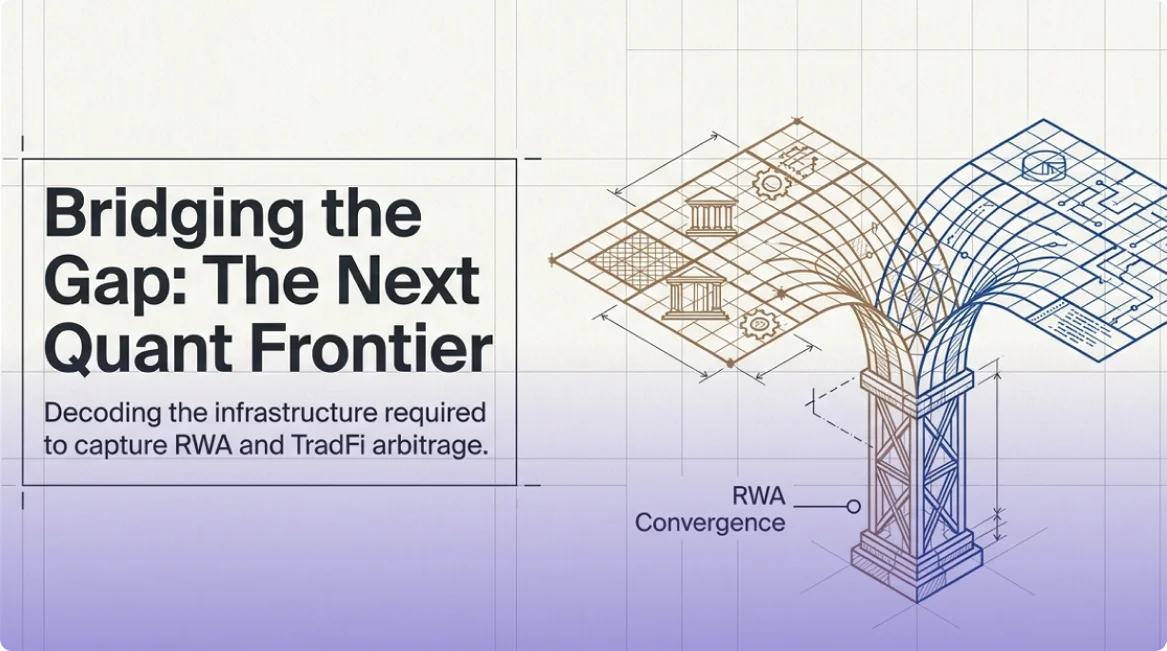
For the past decade, Traditional Finance (TradFi) and Decentralized Finance (DeFi) operated as parallel universes. TradFi offered deep liquidity and regulatory clarity, while DeFi offered atomic settlement and programmability. Today, that wall is collapsing.
The tokenization of Real-World Assets (RWAs)—such as US Treasuries, private credit, and equities—is migrating billions of dollars of institutional capital onto the blockchain. For quantitative trading firms, this convergence has created a massive, expanding frontier: RWA and TradFi Arbitrage.
At ACMIO, this is a core component of our 15+ live market-neutral strategies. But while the alpha in this space is highly attractive, extracting it requires an infrastructure that very few teams possess.
Why RWA and TradFi Arbitrage is Rapidly Expanding
The expansion of this strategy comes down to structural market inefficiencies. Whenever two distinct financial ecosystems are connected, pricing disparities emerge.
- Yield Differentials: Market conditions frequently cause on-chain stablecoin yields to detach from off-chain risk-free rates (like US Treasuries). Quants can capture this spread by shorting the lower-yielding asset and going long on the higher-yielding tokenized equivalent.
- Liquidity Fragmentation: Tokenized assets are traded on decentralized exchanges (DEXs) globally 24/7, while their underlying traditional assets trade on legacy exchanges with strict operating hours. This creates momentary price dislocations between the proxy token and the real-world asset.
- Capital Inefficiencies: Institutional investors often need to rebalance between fiat and crypto rapidly. Arbitrageurs who can facilitate this cross-border liquidity provide a massive service to the market, capturing a premium in the process.
The Execution Reality: What Trading Teams Must Handle
It is one thing to spot a 50-basis-point spread between a tokenized Treasury bill and an off-chain bond; it is an entirely different beast to execute that trade profitably. Teams attempting to enter this space must overcome severe operational and engineering bottlenecks:
1. The Settlement Time Mismatch (T+0 vs. T+1)
Blockchain networks settle transactions atomically in seconds (T+0). Traditional equities and bonds typically settle in T+1 or even T+2 days. If a team is arbitraging an on-chain token against an off-chain asset, they must manage the capital float and inventory risk during that settlement window. A failure to accurately model this timing mismatch can turn a profitable arbitrage into a costly directional exposure.
2. Cross-Domain Infrastructure Complexity You cannot execute TradFi arbitrage with Web3 developers alone, nor can you do it purely with Wall Street veterans. It requires deep cross-domain expertise spanning traditional investment, alternative investment, and digital assets. Teams must seamlessly integrate legacy FIX protocols (for stock brokers) with self-built smart contracts and RPC nodes (for blockchains).
3. Custodial and Counterparty Risk Moving capital back and forth between fiat banking rails and decentralized smart contracts exposes teams to massive counterparty risk. To handle this, teams cannot rely on basic exchange wallets. At ACMIO, our operational security requires segregated on-chain and off-chain infrastructure, utilizing MPC (Multi-Party Computation) and cold wallet custody through institutional partners like Cobo and Ceffu.
4. The Speed of Information Processing In the RWA space, catalysts happen both off-chain (Federal Reserve rate decisions) and on-chain (liquidity pool imbalances). Monitoring both simultaneously requires advanced data parsing. Traditional quants rely on structured data (price, volume). However, navigating the RWA landscape requires processing unstructured data in real-time.