Many engineers and quantitative researchers are currently experiencing a profound sense of whiplash. On one hand, large language models (LLMs) are demonstrating staggering capabilities. On the other, there is a creeping anxiety: If a single prompt can now accomplish what used to require hundreds of lines of code, are human engineers engineering themselves out of a job?
The answer is a definitive no.
While the era of "patch-based engineering"—writing temporary glue code to fix a model's transient limitations, like small context windows—is rapidly ending, a new, permanent discipline is taking its place. The future belongs to those who use deterministic engineering to transform unpredictable, probabilistic AI models into stable, industrial-grade business systems.
At ACMIO, we recognized this shift early. Since the end of 2025, we have fully adopted an agentic flow, ushering in a new era where human quant experts and AI agents collaborate to accomplish what was impossible before.
Here is the engineering blueprint of how we do it, and why system engineering is the ultimate moat in AI-native quantitative trading.
The Core Paradigm: Agent = Model + Harness
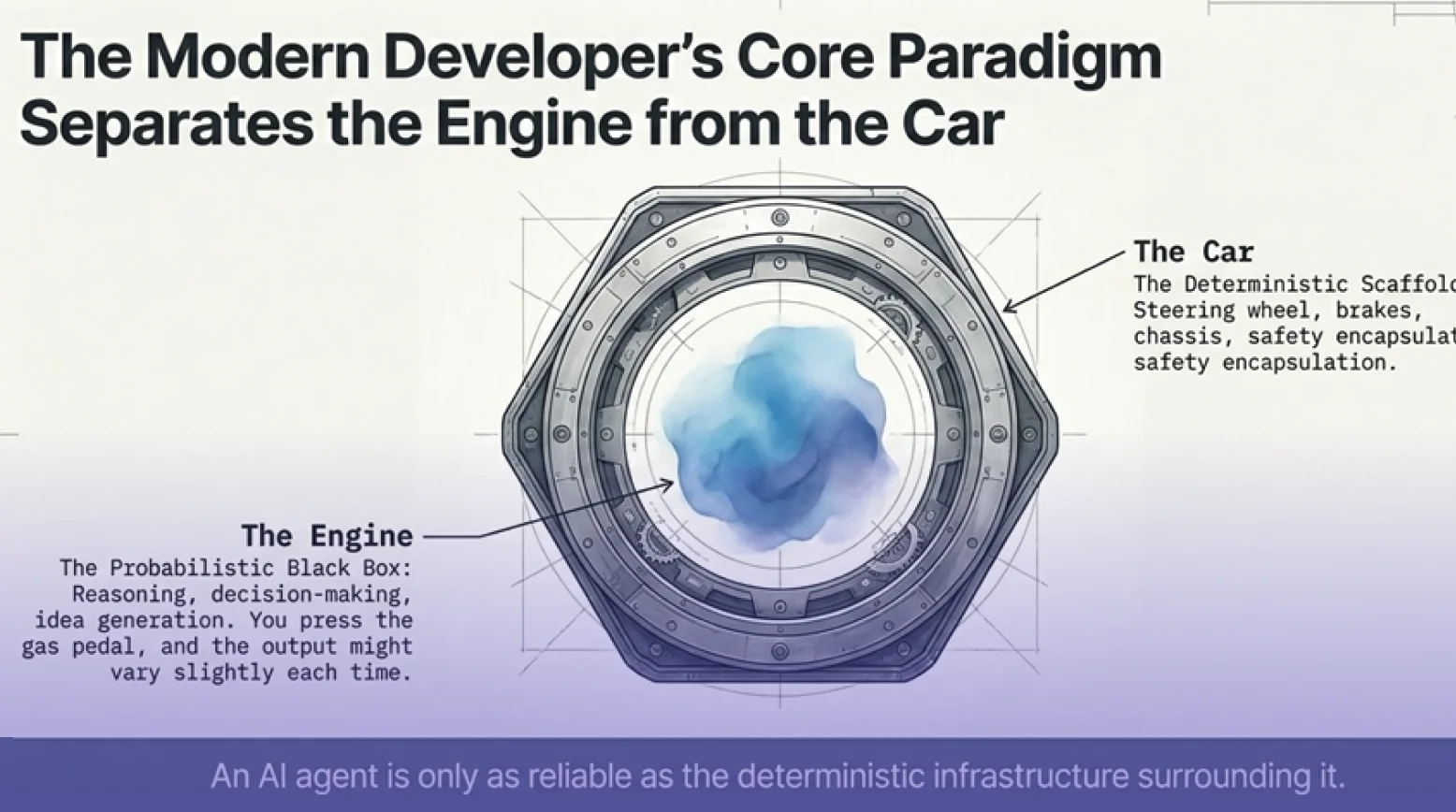
To understand the modern developer's role, we must mentally separate the "engine" from the "car."
- The Model (The Engine): This is the probabilistic black box. It is responsible for reasoning, decision-making, and idea generation. You press the gas pedal, and the output might vary slightly each time.
- The Harness (The Car): This is the deterministic scaffolding—the steering wheel, the brakes, and the chassis.
Engineers are not building the engine; they are building the harness. An AI agent is only as reliable as the deterministic infrastructure surrounding it. A highly intelligent model without a harness is a liability, especially in financial markets. Our job is to use deterministic code to safely encapsulate the model's inherent unpredictability.
The Four Pillars of Agentic Infrastructure
Translating theoretical AI capabilities into robust trading infrastructure requires mastering four fundamental pillars:
1. Context Management
In traditional development, logic and data are strictly separated in databases and codebases. In agentic development, context is the program. Injecting an entire company's operational history into a prompt is like burying a new employee in paperwork; they will lose focus. True context management requires dynamic injection—feeding the agent exactly the market data or alpha inventory it needs at the precise millisecond it needs it, and aggressively compressing historical context to prevent model degradation.
2. Control Flow Design
Traditional code executes in rigid pipelines (A -> B -> C). Agentic workflows operate more like a chessboard, where the model decides the next move. Engineering control flow means defining the boundaries. By forcing the agent to explicitly draft a strategy plan before touching execution APIs, we drastically improve success rates. We do not script the steps; we constrain the sandbox.
3. Error Recovery
When traditional software breaks, it is a bug or a timeout. When an agent breaks, it is often a hallucination or a structural misunderstanding. Blindly writing retry loops for 100 iterations will not solve a hallucinated API call. Robust error recovery means building sandboxed environments where failures are isolated, analyzing the missing tool or context, and dynamically injecting it back into the model's awareness so it can self-correct.
4. Feedback Loops
Historically, system monitoring dashboards were built for human engineers to read. In the agentic era, feedback loops are built for the models. When a trade executes or a tool fails, that result must be asynchronously routed directly back into the model’s context window. This creates a closed-loop system where the agent assesses its own performance and adjusts its strategy without human intervention.
How Agentic Flow Transforms Quantitative Trading at ACMIO
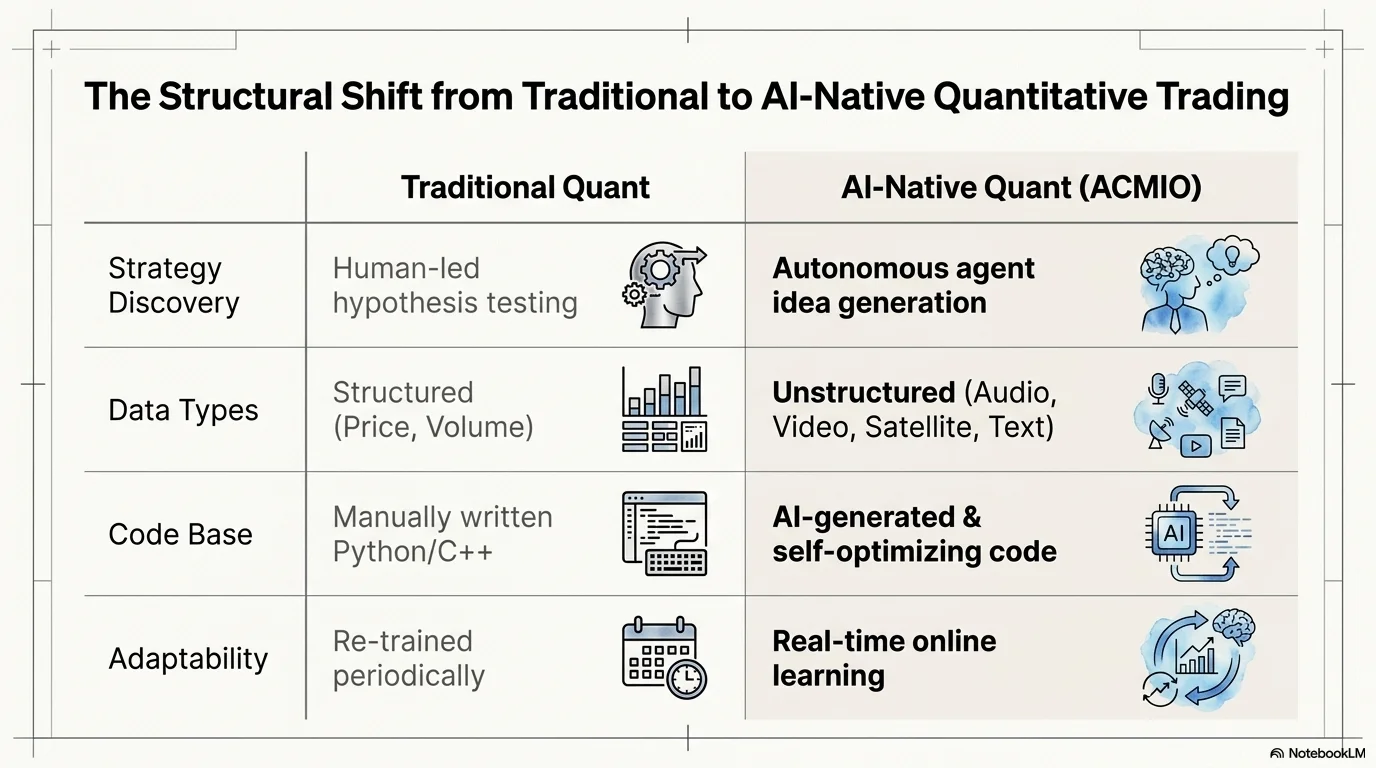
By mastering these four pillars, ACMIO has built an infrastructure where human-led hypothesis testing is replaced by autonomous agent idea generation.
Through our MAGIC (Multi-Agent Generative Investment Copilots) platform, processes that historically took hours or days can now be addressed in minutes or seconds. This is not just a marginal improvement; it is a structural shift in how quantitative trading operates.
The Future of the Quant Engineer
As AI models become exponentially more powerful, the complexity of the required harness increases, not decreases. Physical markets remain messy, APIs will always timeout, and risk parameters must always be strictly enforced.
Frameworks will become obsolete, and specific APIs will be deprecated. But the ability to take a probabilistic black box and engineer it into a reliable, high-velocity trading system? That is a permanent skill. At ACMIO, our engineers aren't just writing code; they are architecting the very environment where artificial intelligence meets the reality of the markets.